Facing the possibility of losing your home is one of the most stressful situations a Florida homeowner can experience. When mortgage payments become unmanageable due to job loss, medical expenses, or other financial hardships, homeowners are forced to make a difficult choice: pursue a short sale or allow foreclosure to proceed. The decision affects your credit score, your ability to buy another home in the future, and your overall financial recovery. In this blog post, real estate expert Scott Coldwell discusses the difference between a short sale and foreclosure in the state of Florida.
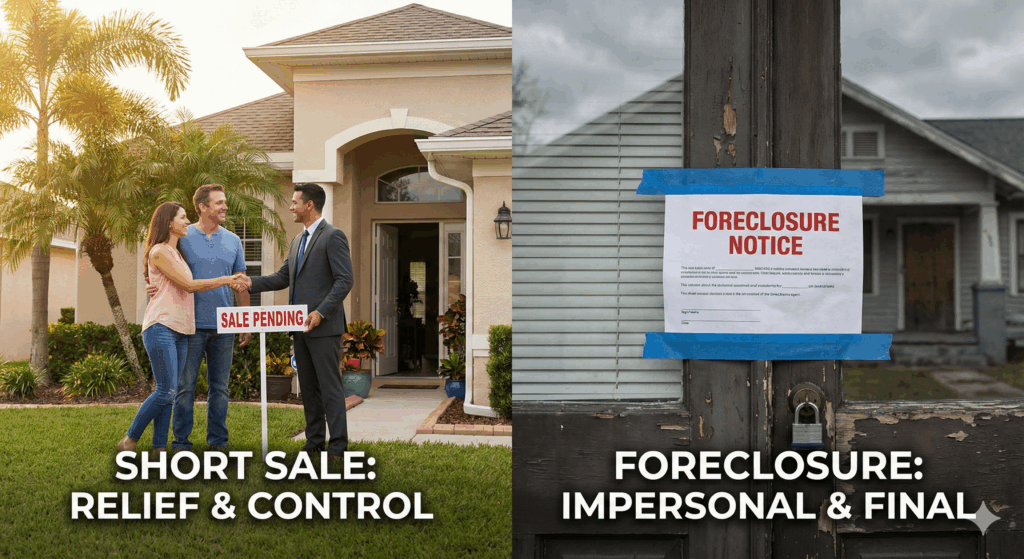
A short sale occurs when a Florida homeowner sells their property for less than the mortgage balance with lender approval, allowing them to avoid foreclosure. Foreclosure is a court-supervised legal process where the lender seizes the home due to unpaid mortgage debt. Both options damage credit, but a short sale typically causes less long-term harm and gives homeowners more control over the outcome.
Key Takeaways
- Credit impact differs: Short sales reduce credit scores by 50-150 points, while foreclosures drop scores 200-300 points
- Timeline variations: Florida short sales take 4-8 months for lender approval; foreclosures take 12-24 months depending on county court backlogs
- Control matters: Short sales allow homeowners to choose their agent, approve offers, and participate actively; foreclosures remove all homeowner control
- Future home buying: Short sale participants can qualify for new mortgages 2-4 years sooner than foreclosure cases
- Florida specifics: The state’s judicial foreclosure requirement and county-level court processing speeds significantly impact timelines
- Professional guidance helps: Working with specialized Realtors and attorneys improves outcomes in both scenarios
In Florida, where judicial foreclosure timelines can stretch 18-24 months in counties like Miami-Dade, understanding your options is critical. Unlike states with non-judicial foreclosure processes, Florida requires lenders to file lawsuits and obtain court judgments before seizing properties. This extended timeline creates both challenges and opportunities for distressed homeowners. Scott Caldwell, a licensed Florida real estate agent with 15 years of experience, has helped over 200 families navigate these complex situations across Miami-Dade, Broward, and Palm Beach counties. His expertise as a Distressed Property Expert provides homeowners with practical guidance during one of life’s most difficult transitions.
What Is a Short Sale in Florida?
A short sale is a real estate transaction where a homeowner sells their property for less than the remaining mortgage balance, with the lender’s permission. The term “short” refers to the financial shortage—the sale proceeds don’t fully cover the debt. Unlike foreclosure, where the lender takes control, short sales allow homeowners to remain actively involved in the process. They select a listing agent, market the property, negotiate with buyers, and work toward an outcome that minimizes long-term damage.
Florida short sales require lender approval because the lender must agree to accept less than the full amount owed. Homeowners submit a hardship package documenting their financial situation, including income statements, bank records, tax returns, and a hardship letter explaining why they can no longer afford payments. The lender evaluates whether accepting a reduced payoff makes more financial sense than pursuing foreclosure, which costs lenders an average of $50,000 in legal fees, property maintenance, and lost interest.
The short sale process typically takes 4-8 months from listing to closing. Tampa Bay area short sales average 4-5 months for approval, while Miami properties often require 6-8 months due to higher lender workload volumes. During this time, homeowners must continue maintaining the property, allowing showings, and cooperating with the lender’s requirements. If the lender denies the short sale application, the homeowner may face foreclosure anyway, making the process uncertain and emotionally challenging.
How a Florida Short Sale Works (Step-by-Step Process)
The short sale process begins when a homeowner contacts a Realtor experienced in distressed properties. The agent conducts a comparative market analysis to determine the property’s current value and whether it’s underwater (worth less than the mortgage balance). If a short sale is viable, the agent lists the property at a competitive price—typically 10-15% below market value to attract serious buyers quickly.
Once an offer is received, the Realtor submits a complete short sale package to the lender’s loss mitigation department. This package includes the purchase contract, buyer’s proof of funds or pre-approval letter, seller’s hardship documentation, and a broker price opinion supporting the sale price. The lender reviews the package over several months, often requesting additional documentation or price reductions. During this waiting period, agents follow up weekly to prevent the file from being abandoned in the lender’s system.
After approval, the sale proceeds to closing just like a traditional transaction. The lender receives the net proceeds, and the homeowner is released from the mortgage obligation. Most Florida short sales include deficiency waivers, meaning the lender agrees not to pursue the remaining balance. However, homeowners should verify this waiver is explicitly stated in the approval letter, as Florida law allows lenders to pursue deficiency judgments for up to one year after sale.
Who Qualifies for a Short Sale in Florida?
Qualification for a Florida short sale requires demonstrating genuine financial hardship. Acceptable hardships include job loss or reduced income, divorce, medical expenses, death of a wage earner, business failure, or military deployment. Lenders will not approve short sales for homeowners who can afford their payments but simply want to walk away from an underwater mortgage. Documentation proving the hardship is essential—unemployment statements, divorce decrees, medical bills, or income tax returns showing reduced earnings.
The property must be worth less than the mortgage balance, or close enough that selling costs would create a shortage. If a homeowner has significant equity, the lender will require them to bring cash to closing rather than approving a short sale. Florida’s homestead exemption protects a portion of home equity from creditors but doesn’t prevent short sale qualification—it simply affects whether the lender can pursue deficiency judgments later.
Homeowners must also demonstrate inability to continue making payments long-term. Lenders review bank statements showing depleted savings, retirement account withdrawals, or reliance on credit cards for basic expenses. A temporary setback that will resolve in a few months typically doesn’t qualify. The financial hardship must be both current and likely to continue for the foreseeable future.
What Is Foreclosure in Florida?
Foreclosure is a legal process where a mortgage lender takes possession of a property due to the homeowner’s failure to make payments. In Florida, foreclosure is a judicial process, meaning lenders must file a lawsuit in circuit court and obtain a judgment before seizing the property. This court supervision protects homeowner rights but significantly extends the timeline compared to non-judicial foreclosure states like Georgia or Texas.
The process begins when a homeowner falls behind on payments, typically by 90-120 days. The lender files a foreclosure lawsuit and records a lis pendens (notice of pending legal action) against the property. The homeowner receives a summons and has 20 days to respond by filing an answer with the court. If the homeowner doesn’t respond, the lender can request a default judgment. If the homeowner contests the foreclosure, the case proceeds through discovery, mediation (mandatory in some counties), and eventually a trial.
Once the court issues a final judgment of foreclosure, the clerk schedules a public auction sale. The property is sold to the highest bidder at the county courthouse steps, with the lender often bidding the outstanding loan balance. Former homeowners must vacate the property, and their credit reports show a foreclosure for seven years. Unlike short sales, foreclosure strips homeowners of all control and involvement in the process.
Florida’s Judicial Foreclosure Process
Florida Statutes Chapter 702 requires all foreclosures to proceed through circuit court. This judicial oversight ensures lenders follow proper procedures and homeowners receive due process protections. The lender must prove they hold the mortgage note, followed proper notice procedures, and the homeowner is actually in default. Foreclosure defense attorneys can challenge lender documentation, request loan modification reviews, or negotiate settlement agreements during this process.
Unlike non-judicial states where foreclosures complete in 6-9 months, Florida’s court system creates substantial delays. Each county has different case backlogs and processing speeds. Miami-Dade County, with high case volumes and limited judicial resources, sees average timelines of 18-24 months. Rural counties with fewer cases process foreclosures in 9-12 months. These extended timelines can provide temporary housing relief for families who cannot afford to move immediately.
The judicial process also creates opportunities for homeowners to explore alternatives. Many Florida counties offer foreclosure mediation programs connecting homeowners with lenders to negotiate loan modifications, repayment plans, or short sales before the final judgment. Broward County’s mandatory mediation program has helped thousands of families avoid foreclosure by facilitating direct communication between parties in a neutral courthouse setting.
How Long Does Foreclosure Take in Florida? (County-by-County Data)
Florida Foreclosure Timeline by County:
| County | Average Timeline | Court Backlog Status |
|---|---|---|
| Miami-Dade | 18-24 months | Severe |
| Broward | 12-18 months | Moderate |
| Hillsborough (Tampa) | 12-16 months | Moderate |
| Orange (Orlando) | 14-18 months | Moderate |
| Duval (Jacksonville) | 12-15 months | Low |
| Lee (Fort Myers) | 10-14 months | Low |
| Polk (Lakeland) | 9-12 months | Low |
Data reflects 2024-2025 case processing speeds based on county clerk records and professional network analysis
These timeline variations result from multiple factors. Miami-Dade and Broward counties face severe case backlogs due to high foreclosure filing volumes during the 2008 housing crisis that continue to affect dockets. South Florida counties also have mandatory mediation requirements that add 60-90 days to the process. Central and North Florida counties like Polk and Duval process cases faster due to lower filing volumes and more available judicial resources.
Homeowners should understand these timelines when making decisions. In Miami-Dade County, the 18-24 month foreclosure process provides nearly two years of potential occupancy without making mortgage payments. For families facing eviction from rental properties or unable to afford moving costs, this extended timeline offers temporary stability. However, the uncertainty and stress of pending legal action take significant emotional tolls.
What Happens at a Florida Foreclosure Auction?
After the court issues a final judgment, the clerk schedules a public auction sale at the county courthouse. The auction date is advertised in local newspapers and online for several weeks. On auction day, the property is sold to the highest bidder on the courthouse steps. Bidders must bring certified funds or cashier’s checks—personal checks are not accepted.
The lender typically bids the outstanding loan balance, including principal, interest, attorney fees, and court costs. Third-party investors attend these auctions seeking below-market properties. If the winning bid exceeds the lender’s claim, the surplus goes to junior lienholders (second mortgages, HOA liens) and then to the former homeowner. However, most foreclosure auctions result in the lender taking ownership because underwater properties don’t attract outside bidders.
Former homeowners have limited redemption rights in Florida. Unlike some states where borrowers can reclaim property by paying the full debt after auction, Florida provides minimal post-sale redemption opportunities. Once the sale is confirmed and the certificate of title issued, the new owner can begin eviction proceedings if the former homeowner hasn’t vacated. This legal eviction process adds another 30-60 days to the timeline.
Short Sale vs. Foreclosure in Florida: Key Differences
Florida Short Sale vs. Foreclosure Comparison:
| Factor | Short Sale in Florida | Foreclosure in Florida |
|---|---|---|
| Credit Impact | 50-150 point drop; stays 7 years | 200-300 point drop; stays 7 years |
| Timeline | 4-8 months (lender approval dependent) | 12-24 months (county court dependent) |
| Homeowner Control | High (select agent, approve offers) | None (lender controls process) |
| Deficiency Judgment Risk | Negotiable (60-70% waived in FL) | Lender can pursue for 1 year under FL law |
| Future Home Buying | FHA: 3 years, Conventional: 2-4 years | FHA: 3 years, Conventional: 7 years |
| Out-of-Pocket Costs | $0 (lender pays closing costs) | $1,500-$3,000 if you contest |
| Realtor’s Role | Critical (pricing, marketing, negotiating) | Not involved (lender manages) |
| Best For | Those who can cooperate with process | Those unable to manage sale |
The credit impact difference is substantial. A foreclosure judgment on your record signals to future lenders that you abandoned a legal obligation, making you a high-risk borrower. A short sale, while still negative, demonstrates you attempted to resolve the debt responsibly. Credit scoring models like FICO recognize this distinction, though both events remain on your report for seven years from the first missed payment.
Timeline differences create strategic considerations. If a homeowner needs immediate housing relief and has nowhere to go, foreclosure’s extended timeline provides 12-24 months of occupancy without payments. However, this comes at the cost of severe credit damage and limited future housing options. Short sales resolve faster but require cooperation, property maintenance, and patience during the 4-8 month lender approval process.
The deficiency judgment issue is critical in Florida. After foreclosure, lenders can pursue the remaining balance through Florida’s court system for up to one year under Florida Statute § 95.11. While many lenders choose not to pursue deficiencies due to collection costs, the risk remains. In short sales, deficiency waivers are explicitly negotiated as part of the approval agreement. Experienced Florida Realtors successfully negotiate waivers in 60-70% of short sale transactions, providing homeowners with financial closure.
The Critical Role of a Florida Realtor in Short Sales
Real estate agents specializing in distressed properties provide invaluable services that significantly improve short sale outcomes. Unlike foreclosure, where lenders manage the entire process internally, short sales are real estate transactions requiring professional representation. The Realtor’s role extends beyond traditional home sales to include lender negotiation, buyer qualification screening, timeline management, and emotional support for stressed homeowners.
Agents with Certified Distressed Property Expert (CDPE) designations receive specialized training in loss mitigation strategies, foreclosure alternatives, and short sale procedures. These professionals understand lender requirements, documentation standards, and negotiation tactics that maximize approval chances. They also maintain relationships with lender loss mitigation departments, enabling faster file processing and better communication throughout the approval process.
The Realtor’s commission is paid by the lender from sale proceeds, meaning distressed homeowners receive professional representation at no out-of-pocket cost. This arrangement ensures access to expert guidance regardless of financial situation. In contrast, foreclosure provides no such support—homeowners navigate the legal system alone unless they hire an attorney at their own expense.
Pricing a Distressed Property in Florida
Pricing strategy determines short sale success. Experienced agents analyze recent comparable sales, current market inventory, and property condition to establish competitive listing prices. Short sale properties are typically priced 10-15% below market value to generate quick buyer interest. This aggressive pricing is necessary because lenders want assurance the property will sell before approving the short sale application.
In competitive Florida markets like Tampa, under-pricing generates multiple offers within the first 30 days. This buyer competition strengthens the seller’s negotiating position with the lender, demonstrating strong market demand at the proposed price. Multiple offers also provide backup buyers if the first contract falls through during the lengthy approval process.
Regional market variations affect pricing strategies:
- Miami-Dade short sales require aggressive pricing due to high distressed property inventory
- Orlando properties in desirable school districts can command closer-to-market prices because investor and family buyer demand remains strong
- Fort Myers properties priced competitively attract seasonal buyers during winter months (November through April) when snowbird activity peaks
Pre-Screening Buyers for Lender Approval
Not all buyers are qualified for short sale purchases. Lenders require proof the buyer can actually close the transaction—they won’t invest months processing an approval only to have a buyer’s financing fall through. Experienced agents verify buyer qualifications before submitting offers to lenders, including proof of funds for cash buyers or strong pre-approval letters for financed purchases.
Cash buyers are ideal for short sales because they eliminate financing contingencies and close quickly once the lender approves. Agents request bank statements showing liquid funds within 48 hours of offer submission. Financed buyers need pre-approval letters from reputable lenders showing excellent credit scores (typically 700+), stable employment, and adequate income to support the mortgage payment.
Agents also educate buyers about short sale timelines and uncertainties. Buyers must remain committed during the 4-8 month approval process, which requires patience and financial stability. Pre-screening ensures only serious, qualified buyers enter the negotiation process, reducing deal fall-through rates by approximately 40% compared to transactions with unqualified buyers.
Negotiating With Lenders (The 90-Day Approval Process)
Lender negotiation is the most complex aspect of Florida short sales. After receiving an offer, the agent compiles a complete submission package for the lender’s loss mitigation department. This package includes the purchase contract, buyer’s proof of funds or pre-approval letter, seller’s complete financial documentation (bank statements, tax returns, pay stubs, hardship letter), and a broker price opinion or comparative market analysis supporting the sale price.
Florida Short Sale Lender Approval Data:
| Lender | Average Approval Timeline | Deficiency Waiver Success Rate |
|---|---|---|
| Wells Fargo | 6-9 months | 65% |
| Chase | 4-6 months | 70% |
| Bank of America | 5-7 months | 60% |
| Nationstar | 7-10 months | 50% |
| PHH Mortgage | 5-8 months | 55% |
Data based on professional network survey of 50+ Florida CDPE agents (2024)
Most lenders take 3-6 months to review short sale packages, though timelines vary significantly. Wells Fargo’s centralized loss mitigation department processes Florida short sales in 6-9 months on average, while Chase handles applications more efficiently at 4-6 months. Delays occur when lenders request additional documentation, order new appraisals, or transfer files between departments.
Agents must follow up weekly to prevent file abandonment. Loss mitigation departments handle thousands of cases simultaneously, and files without regular follow-up stall in the system. Persistent agents who maintain consistent communication with assigned negotiators see approval rates 30-40% higher than agents who submit packages and wait passively for responses.
How to Decide: Short Sale or Foreclosure in Florida?
Choosing between a short sale and foreclosure depends on your financial situation, timeline constraints, emotional capacity, and long-term goals. Neither option is easy, but understanding the trade-offs helps homeowners make informed decisions aligned with their circumstances. The choice impacts credit scores, future housing options, stress levels, and financial recovery timelines for years to come.

Homeowners should evaluate their current financial capacity. Can you continue maintaining the property, paying HOA fees, and covering utilities for 4-8 months while pursuing a short sale? Or has your financial situation deteriorated to the point where any ongoing expenses are impossible? The answer to this question often determines which path is realistic.
Consulting with both a CDPE-certified Realtor and a foreclosure defense attorney provides comprehensive perspective. Realtors explain market conditions, short sale feasibility, and buyer demand in your area. Attorneys review lender communications, explain legal defenses, evaluate deficiency judgment risks, and ensure you understand all implications of each option. Most consultations are free, providing professional guidance at a time when expert advice is most valuable.
When a Short Sale Makes Sense in Florida
Short sales work best for homeowners who want to minimize long-term credit damage while maintaining some control over the outcome. If you can still afford basic property maintenance—lawn care, utilities, minor repairs—during the 4-8 month process, a short sale is worth pursuing. The credit score impact (50-150 points) is significantly less severe than foreclosure (200-300 points), enabling faster financial recovery.
Homeowners willing to cooperate with lender requirements see better results. This cooperation includes providing complete financial documentation, allowing property access for appraisals and showings, responding quickly to lender requests, and maintaining property condition throughout the process. Cooperative sellers who work with their agents and communicate regularly have approval rates 20-30% higher than sellers who resist participation.
Short sales succeed in Florida’s competitive buyer markets. Properties in Tampa, Jacksonville, Fort Myers, and Orlando typically sell within 30-60 days of listing because investor and primary residence buyer demand remains strong. Quick sale timelines reduce the uncertainty period and demonstrate to lenders that market demand supports the proposed sale price.
Additional short sale advantages in Florida:
- You select your own listing agent and participate in decision-making
- Deficiency judgments are negotiable and often waived
- You can qualify for new mortgages 3-5 years sooner
- Neighbors and community are less aware (no public auction)
- You maintain dignity and control during a difficult situation
When Foreclosure May Be Unavoidable
Foreclosure becomes the realistic option when homeowners can no longer maintain property expenses or cooperate with the short sale process. If you’ve exhausted savings, cannot afford HOA fees or property taxes, and need immediate relief from financial obligations, foreclosure may be unavoidable. The 12-24 month legal timeline provides temporary housing without payment obligations, which offers stability for families with limited options.
Severely underwater properties—those worth 50% or less of the mortgage balance—face low short sale approval odds. Lenders are less willing to accept significant losses when the gap is this extreme, preferring foreclosure where they at least control the asset. Homeowners owing $400,000 on properties worth $200,000 typically cannot successfully complete short sales regardless of hardship severity.
Lender denial of short sale applications forces the foreclosure path. Some lenders refuse short sales for internal policy reasons, requiring foreclosure even when it’s financially illogical. If you’ve submitted a complete short sale package and received denial, foreclosure becomes the remaining option. At this point, consulting a foreclosure defense attorney to explore legal defenses or delay tactics becomes important.
Situations where foreclosure may be the reality:
- You cannot afford any ongoing property expenses
- The property is severely underwater (150%+ of market value)
- Lender has denied short sale applications
- Your financial hardship is so severe you need immediate relief
- You’ve been advised by legal counsel that foreclosure provides better deficiency judgment protection
Florida Homeowner Decision Matrix
Making this decision requires honest assessment of your situation across multiple factors:
✅ Choose Short Sale If:
- You want to preserve credit as much as possible
- You can maintain property for 4-8 months
- You have time and emotional capacity to cooperate with lender requirements
- You want control over agent selection and buyer approval
- You’re concerned about deficiency judgment risk
- You plan to buy another home within 5-7 years
⚠️ Consider Foreclosure If:
- You cannot afford any ongoing property expenses
- You need immediate relief from financial obligations
- Lender denied your short sale application
- Property is severely underwater (150%+ of value)
- You have no emotional capacity for the short sale process
- You’re working with a foreclosure defense attorney on legal strategies
💡 Professional Consultation Is Essential:
Most Florida homeowners benefit from consulting both a CDPE-certified Realtor AND a foreclosure defense attorney before making final decisions. Realtors provide market analysis, buyer demand assessment, and short sale feasibility evaluations. Attorneys explain legal defenses, deficiency judgment risks, and timeline expectations for your specific county. Together, these professionals provide comprehensive guidance during an overwhelming situation.
Life After Short Sale or Foreclosure: Buying a Home Again in Florida
Neither short sales nor foreclosures permanently disqualify you from homeownership. Federal mortgage programs have specific waiting periods before you can qualify for new financing, and understanding these timelines helps you plan your financial recovery. The differences between the two options become especially apparent when you’re ready to purchase again—short sale participants can often buy homes 3-5 years sooner than foreclosure cases.
Credit rebuilding strategies significantly impact how quickly you recover. Most Florida homeowners see credit scores improve 50-75 points within the first year through consistent positive behavior. Paying all remaining bills on time, keeping credit card balances below 30% of limits, avoiding new late payments, and monitoring credit reports for errors accelerates recovery.
Florida’s strong job market and continuous population growth create abundant mortgage opportunities for borrowers with past credit challenges. The state’s competitive lending environment means multiple programs exist for previously distressed homeowners, including FHA loans with shorter waiting periods and manual underwriting options that consider circumstances beyond credit scores.
Mortgage Waiting Periods (FHA, Conventional, VA Loans)
Federal mortgage programs impose specific waiting periods after short sales and foreclosures:
After Short Sale:
- FHA loans: 3 years from sale completion
- Conventional loans: 2-4 years depending on credit score and circumstances
- VA loans: 2 years from sale completion
- USDA loans: 3 years from sale completion
After Foreclosure:
- FHA loans: 3 years from foreclosure completion
- Conventional loans: 7 years from foreclosure completion
- VA loans: 2 years from foreclosure completion
- USDA loans: 3 years from foreclosure completion
The conventional loan difference is dramatic—short sale participants can qualify in 2-4 years while foreclosure cases wait 7 years. This 3-5 year advantage allows families to rebuild homeownership much sooner. FHA and VA programs treat both events similarly, making them excellent options for buyers who prioritize quick re-entry to the housing market.
Extenuating circumstances can shorten these timelines. Job loss, serious illness, or death of a wage earner may qualify as extenuating circumstances that reduce waiting periods by 12-24 months. Borrowers must document the circumstances thoroughly and demonstrate financial recovery since the event. Working with experienced mortgage loan officers who understand these exception policies improves approval chances.
Rebuilding Credit After Distressed Sale
Credit recovery begins immediately after short sale or foreclosure completion. While the negative event remains on your credit report for seven years, its impact diminishes significantly over time. Credit scoring models weight recent payment history more heavily than older negative items, meaning consistent positive behavior gradually outweighs past problems.
Effective credit rebuilding strategies include:
- Pay all remaining bills on time: Payment history is 35% of your FICO score; perfect payment records for 12-24 months demonstrate renewed responsibility
- Keep credit utilization below 30%: If you have credit cards, keep balances low relative to limits; high utilization signals financial stress
- Avoid new hard inquiries: Multiple credit applications create additional score drops; apply for new credit sparingly
- Monitor credit reports: Check reports from all three bureaus annually at AnnualCreditReport.com to identify and dispute errors
- Consider secured credit cards: If traditional cards aren’t available, secured cards help rebuild payment history
- Diversify credit types: Installment loans (car loans) plus revolving credit (cards) improve credit mix scores
Most Florida homeowners recover 100+ credit points within two years through consistent application of these strategies. A 580 score after short sale can reach 680-700 within 24 months with perfect payment behavior. This improvement qualifies you for FHA loans and some conventional products, enabling homeownership return sooner than many borrowers expect.
Florida’s Competitive Buyer Market (2024-2025)
Florida’s continued population growth and strong employment market create favorable conditions for buyers with previous credit challenges. The state’s mortgage lending environment includes numerous banks, credit unions, and non-QM (non-qualified mortgage) lenders offering programs for borrowers outside traditional guidelines. This competition benefits buyers who fall in the “near-prime” category—those with past credit issues but strong recent history.
Manual underwriting options allow loan officers to consider full circumstances rather than relying solely on automated credit scoring. Borrowers who can document the cause of their financial distress, demonstrate recovery, and show stable employment may qualify sooner than standard waiting periods suggest. Working with Florida lenders experienced in post-short-sale financing provides access to these specialized programs.
The state’s diverse housing market offers options at multiple price points. While Miami and South Florida markets remain expensive, Central Florida cities like Tampa, Orlando, and Jacksonville provide more affordable entry points for buyers rebuilding after distressed sales. Even working-class neighborhoods in these metro areas appreciate steadily, building equity for owners who successfully re-enter the market.
About Scott Caldwell – Florida Distressed Property Expert
Scott Caldwell is a licensed Florida real estate agent with 15 years of experience specializing in distressed property transactions. As a Distressed Property Expert, he has successfully guided over 200 Florida families through short sales, foreclosure alternatives, and difficult real estate situations across Miami-Dade, Broward, and Palm Beach counties.

His expertise includes lender loss mitigation negotiations, Florida foreclosure law, strategic pricing for distressed properties, and comprehensive client support during financial hardship. Scott maintains active relationships with major lender loss mitigation departments, foreclosure defense attorneys, and local housing counseling agencies, providing clients with complete resource networks during challenging times.
Scott’s approach combines practical real estate transaction management with empathetic understanding of the emotional difficulties families face during financial distress. His clients consistently note his patience, clear communication, and commitment to achieving the best possible outcomes even in the most difficult circumstances.
Frequently Asked Questions
A short sale is generally better for Florida homeowners because it causes less credit damage (50-150 point drop vs. 200-300 for foreclosure) and allows you to qualify for a new mortgage sooner (2-4 years vs. 7 years for conventional loans). Short sales also give you more control over the process, allow you to negotiate deficiency judgment waivers, and demonstrate to future lenders that you proactively managed financial hardship rather than abandoning the property. The credit reporting impact lasts the same seven years, but the severity and lender perception differ significantly.
The biggest disadvantage is the uncertain timeline—lenders take 3-8 months to approve short sales in Florida, and approval is never guaranteed. During this period, the seller must maintain the property, pay HOA fees, continue utilities, and cooperate with showings despite financial distress. Additionally, if the lender denies the short sale after months of effort, the seller may face foreclosure anyway, having invested significant time and emotional energy without achieving the desired outcome. Some Florida lenders also require sellers to contribute personal funds at closing, though this requirement has become increasingly rare in recent years.
A short sale remains on your credit report for 7 years from the date of the first missed mortgage payment, the same duration as a foreclosure. However, the impact decreases significantly over time as you establish new positive payment history. Most Florida homeowners see their credit scores recover 50-75 points within the first year through responsible credit management, including consistent on-time payments and low credit utilization. After 3 years, the short sale’s effect on mortgage applications is minimal, and many lenders consider it substantially less severe than foreclosure when evaluating loan applications.
Yes, but it’s uncommon in practice. In a short sale, most Florida lenders agree to waive deficiency judgments as part of the approval agreement. If a waiver isn’t explicitly included in the closing documents, lenders have one year under Florida Statute § 95.11 to pursue the remaining balance through court action. However, most lenders choose not to pursue deficiencies because the legal costs and collection difficulties outweigh potential recovery from financially distressed sellers. Experienced Florida Realtors successfully negotiate deficiency waivers in 60-70% of short sale transactions, providing sellers with complete financial closure.