Understanding what constitutes a red flag in a mortgage application is crucial for Florida homebuyers navigating one of the nation’s most competitive and complex real estate markets. A red flag in mortgage underwriting refers to any financial, employment, credit, or property-related situation that raises concerns about a borrower’s ability or willingness to repay the loan. While national lenders focus on universal approval criteria like credit scores and debt-to-income ratios, Florida presents unique challenges including property insurance availability crises, flood zone financing complications, and post-Surfside condo regulations that can derail financing even for well-qualified buyers. In this blog post, Ocala real estate expert Scott Coldwell discusses what mortgage lenders consider red flags, with specific focus on challenges facing North Central Florida homebuyers in Ocala, Gainesville, and surrounding markets.
A red flag in a mortgage application is any financial or personal situation that raises concerns about a borrower’s ability or willingness to repay the loan. Common mortgage red flags include high debt-to-income ratios above 43%, recent late payments or collections on credit reports, unexplained large deposits in bank accounts, frequent job changes or employment gaps, and insufficient cash reserves for closing costs. In Florida, additional property-specific red flags include difficulty obtaining homeowners insurance, properties in flood zones without elevation certificates, condos with inadequate reserve funding under SB 154 requirements, and unpermitted additions discovered during inspections.
Key Takeaways
- Credit and debt red flags include DTI ratios above 43%, recent late payments, collections, and multiple credit inquiries within 90 days—issues that require proactive resolution before applying
- Employment and income verification red flags like frequent job changes, declining self-employment income, or undocumented cash deposits raise questions about repayment ability and stability
- Florida-specific property red flags such as uninsurable homes, flood zone premium shock, condo reserve funding deficiencies (SB 154), and unpermitted additions can derail financing at the last minute
- Proactive preparation through pre-approval consultation with experienced Florida realtors and local lenders helps buyers identify and resolve red flags before making offers
To Discuss Your Home Sale or Purchase, Call or Text Today and Start Packing!
Scott Coldwell has guided over 1,500 Florida homebuyers through the mortgage approval process during his 19+ years in North Central Florida real estate, working directly with local lenders to help clients navigate common red flags and secure financing. His team’s experience selling 500+ homes annually means he has seen virtually every mortgage complication that can arise in the Ocala, Gainesville, and Dunnellon markets, from insurance availability issues to employment verification challenges for seasonal workers.
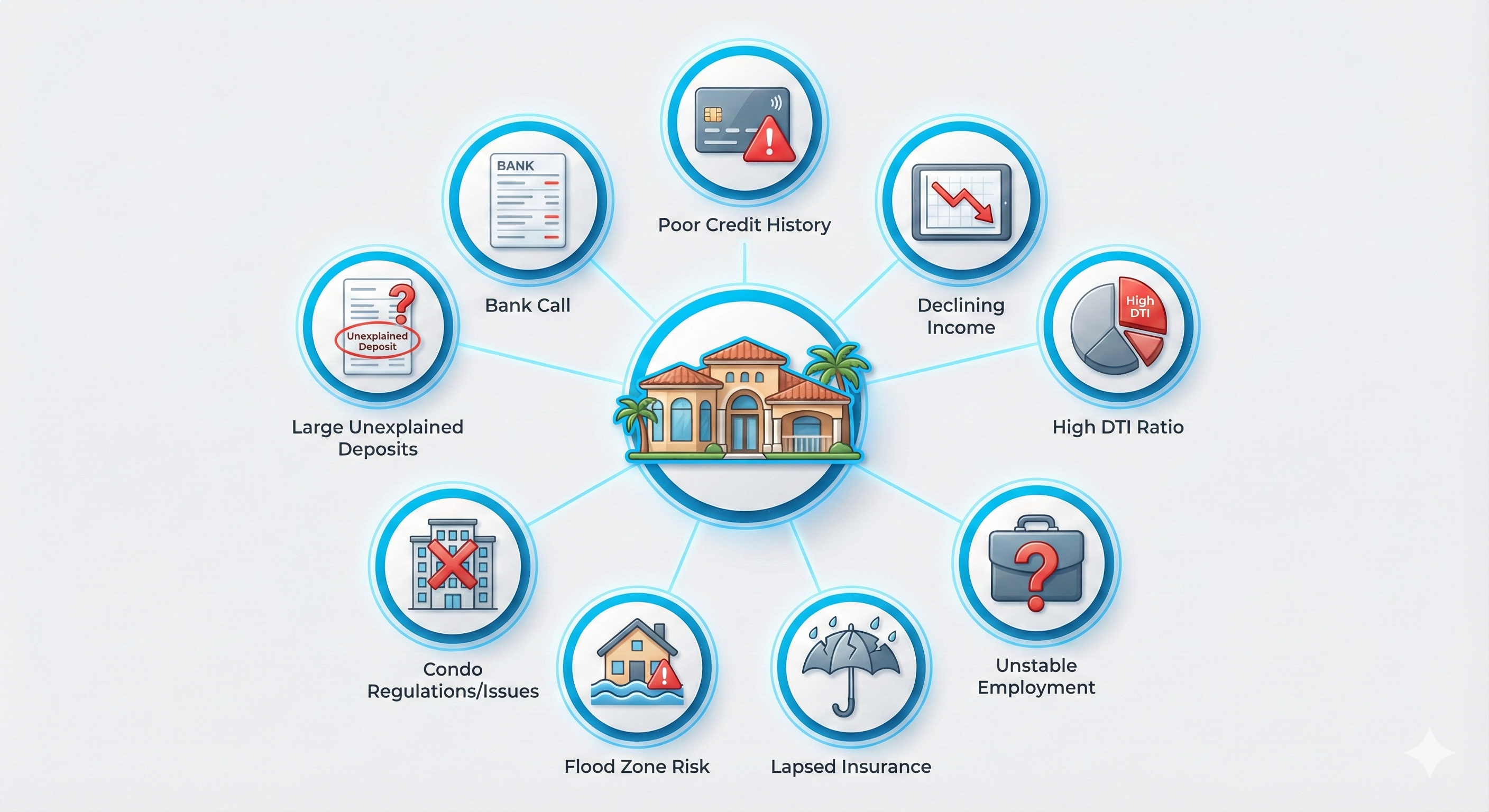
8 Critical Mortgage Red Flags for Florida Homebuyers
Credit History
- Recent late payments (past 12 months) are weighed more heavily than older issues.
- Mortgage and rent delinquencies trigger the most serious concerns for underwriters.
- Non-medical collections typically require resolution before closing.
Property Insurance
- Many carriers refuse to insure homes with roofs older than 15 years without a full replacement.
- Failed 4-point inspections (electrical, plumbing, HVAC) can make a property uninsurable.
- If only Citizens (FL’s insurer of last resort) will provide coverage, some lenders may decline the loan.
Debt-to-Income Ratio
- Conventional loans typically have a maximum DTI ratio of 43%; exceeding this is a major red flag.
- Florida’s soaring insurance and tax costs can unexpectedly push a qualified DTI into denial.
Income/Employment
- Lenders verify two years of continuous employment and look for stable or increasing income.
- Declining income trends for self-employed or seasonal workers are a major concern.
- Large amounts of undocumented cash income cannot be used for loan qualification.
Job Stability
- Frequent job changes, especially to a different industry or with a pay cut, signal instability.
- Employment gaps longer than 30 days require a detailed written explanation.
- Switching from a W-2 job to self-employment right before buying is a significant red flag.
Assets & Deposits
- Any large, non-payroll deposit in your bank statements must be sourced and documented.
- Undocumented cash deposits are a red flag, as funds can’t come from an undisclosed loan.
Condo Regulations
- Per Florida law (SB 154), condo associations must have fully funded reserves for structural components.
- Under-funded reserves or large pending assessments can make a unit un-financeable.
Flood Zones
- Properties in Special Flood Hazard Areas (SFHAs) require mandatory, expensive flood insurance.
- Lenders may have stricter requirements for properties in high-risk zones (e.g., VE-zones).
What Mortgage Lenders Look For: The Core Approval Criteria
Mortgage lenders evaluate applications using three fundamental criteria known as the “Three C’s”: Credit, Capacity, and Collateral. Credit refers to a borrower’s history of repaying debts, typically measured through credit scores and payment history on existing obligations. Capacity measures whether borrowers can afford monthly mortgage payments based on income, employment stability, and existing debt obligations. Collateral represents the property itself, which must meet minimum standards for value, condition, and insurability. Consequently, understanding these core approval factors helps Florida homebuyers recognize why certain situations trigger red flags for underwriters.
The Ocala real estate market adds complexity to these universal standards, particularly regarding capacity and collateral evaluation. Property insurance premiums that have doubled or tripled since 2022 significantly impact capacity calculations, potentially pushing otherwise qualified buyers over the 43% debt-to-income threshold. Meanwhile, flood zone locations and aging infrastructure in older Florida homes create collateral concerns that don’t exist in many other markets. Therefore, Florida buyers must address both universal approval criteria and state-specific complications to avoid red flags.
Credit History: What “Good” Means to Lenders
Minimum credit scores vary by loan type, with conventional loans typically requiring 620 or higher, FHA loans accepting scores as low as 580, and VA loans generally requiring 620 despite no official minimum. However, credit scores represent only part of the credit evaluation picture. Lenders scrutinize payment history patterns, with recent late payments weighted more heavily than older issues. For example, a 30-day late payment from 36 months ago raises fewer concerns than multiple late payments within the past 12 months.
Florida buyers should note that insurance payment history now appears on credit reports following the state’s crackdown on Assignment of Benefits (AOB) fraud. Late payments to property insurance carriers can therefore impact mortgage qualification just as seriously as late payments on credit cards or auto loans. This recent development means maintaining current insurance premiums becomes critical even before starting the home buying process.
Capacity: Proving You Can Afford the Payments
Capacity assessment centers on debt-to-income ratio calculation: total monthly debt obligations divided by gross monthly income, expressed as a percentage. Lenders evaluate both front-end ratios (housing expenses only, typically 28% maximum) and back-end ratios (all debt including housing, typically 43% maximum for conventional loans). For instance, a buyer earning $6,000 monthly with $2,600 in total debt payments would have a 43.3% DTI ratio—just above the conventional loan threshold.
Florida’s elevated insurance costs frequently surprise buyers during capacity evaluation. When homeowners insurance premiums reach $4,000-$6,000 annually for inland properties or $8,000-$12,000 for coastal areas, the monthly insurance component adds $333-$1,000 to housing expense calculations. Additionally, mandatory flood insurance for properties in Special Flood Hazard Areas can add another $1,200-$8,000 annually. These Florida-specific costs can transform a seemingly comfortable 38% DTI into an unqualified 45% DTI.
Collateral: The Property Must Meet Lender Standards
The property securing the mortgage must appraise at or above the purchase price, maintain safe and habitable condition, and qualify for property insurance coverage. Appraisal shortfalls create immediate red flags, as lenders limit loan amounts to the appraised value regardless of contract price. Property condition issues discovered during inspections can trigger concerns, particularly if they affect safety, structural integrity, or habitability.
Property insurability represents the most significant collateral red flag in Florida’s current market. If a property cannot obtain insurance coverage from admitted carriers, many conventional lenders will decline financing even for otherwise qualified buyers. Moreover, properties requiring Citizens Property Insurance Corporation (Florida’s insurer of last resort) may face additional scrutiny or higher down payment requirements from some lenders due to Citizens’ limited financial stability compared to national carriers.
“The biggest surprise for Ocala buyers in 2024-2025 has been property insurance impact on capacity calculations. When homeowners insurance jumped from $1,500 to $4,500 annually, that extra $250 per month changed many borrowers’ DTI from qualified to denied.” – Scott Coldwell
Credit and Debt Red Flags Florida Mortgage Lenders Watch
Credit-related red flags extend beyond simple credit score thresholds to encompass payment patterns, debt levels, and recent credit-seeking behavior. Understanding which credit issues represent minor concerns versus major obstacles helps Florida buyers prioritize remediation efforts. Additionally, some credit red flags specific to Florida’s market conditions require specialized knowledge to address effectively.
Recent Late Payments: Timing Matters More Than You Think
Late payments reported within the past 12 months carry significantly more weight than older delinquencies, as underwriters focus on current payment behavior as predictive of future performance. Mortgage and rent payment delinquencies trigger the most serious concerns since they directly relate to housing payment reliability. A single 30-day late mortgage payment within the past year may require extensive documentation and explanation, while multiple late payments typically result in denial for conventional financing.

Medical collections often receive special consideration, as most lenders exclude medical debts under $500 from credit evaluation and accept reasonable explanations for larger medical collections. However, non-medical collections, particularly from utility companies, cell phone providers, or credit cards, require resolution before closing. Florida buyers should be particularly aware that HOA collections from previous residences appear on credit reports and must be paid or settled regardless of disputes with former associations.
Isolated late payments often qualify for letter of explanation treatment if borrowers can demonstrate the delinquency resulted from temporary circumstances. For example, medical emergencies, job loss, or natural disasters generally receive more lenient consideration than unexplained recent delinquencies. Late payments during the 2020 COVID-19 pandemic typically receive similar understanding from underwriters.
High Debt-to-Income Ratio: The 43% Threshold Rule
Conventional loan programs typically impose a 43% maximum back-end DTI ratio, though some programs allow up to 50% with strong compensating factors like high credit scores, substantial cash reserves, or significant down payments. FHA loans offer more flexibility, accepting DTI ratios up to 56.9% in some cases when automated underwriting systems approve the application. Nevertheless, higher DTI ratios increase scrutiny and require stronger documentation of income stability and credit management.
Florida’s insurance costs directly impact DTI calculations in ways many first-time buyers don’t anticipate. Consider a buyer with $5,000 monthly gross income purchasing a $250,000 home. The costs include:
- $1,200 monthly mortgage payment
- $400 property taxes
- $450 insurance
- $100 HOA fees
This totals $2,150 in housing costs. When combined with $700 in existing debt payments (car loan, student loans, credit cards), the total debt reaches $2,850 monthly, producing a 57% DTI ratio that exceeds most program limits despite the mortgage payment itself being reasonable.
Strategies to reduce DTI before applying:
- Pay down revolving credit card balances to reduce minimum payment obligations
- Avoid taking on new debt for furniture, appliances, or vehicles during the home buying process
- Add a co-borrower with income to increase the denominator in DTI calculations
- Consider less expensive properties that generate lower housing payment obligations
- Increase income through raises, bonuses, or second jobs (requires 2-year history for most income sources)
Multiple Recent Credit Inquiries: The 90-Day Window
Five or more credit inquiries within 90 days signal credit desperation to underwriters, suggesting the applicant may be overleveraged or experiencing financial stress. Fortunately, mortgage shopping inquiries receive special treatment—multiple mortgage applications within a 45-day period count as a single inquiry for scoring purposes. However, inquiries for auto loans, credit cards, personal loans, and retail financing each count separately and accumulate quickly.
Florida buyers should exercise particular caution about financing furniture, appliances, or vehicles during the home buying process. The combination of credit inquiry impact and increased monthly debt obligations from new financing frequently pushes borderline applications into denial territory. Working with the best realtor in Ocala helps buyers understand timing considerations and avoid costly mistakes during the mortgage process.
Employment and Income Verification Red Flags
Employment stability and income adequacy represent critical approval factors that generate numerous red flags when documentation reveals concerning patterns. Lenders verify employment history, income consistency, and income sources to ensure borrowers can sustain monthly payments throughout the loan term. Florida’s unique economy, with substantial tourism, seasonal, and self-employment sectors, creates specific verification challenges that require careful navigation.
Job Changes and Employment Gaps: The 2-Year Stability Rule
Mortgage lenders verify two years of continuous employment history through W-2 forms, pay stubs, and direct employer verification calls. Job changes within the same career field generally pass scrutiny, particularly when accompanied by salary increases or promotions. However, changes to entirely different industries, especially with salary reductions, trigger red flags about income stability. Employment gaps exceeding 30 days require written explanations addressing the reasons for unemployment and demonstrating current employment stability.
Acceptable job change scenarios include:
- Promotion within the same company with salary increase
- Lateral move to competitor in same industry with comparable or higher pay
- Career advancement to new company in same field with documented salary increase
- Return to workforce after education (supported by degree completion)
Red flag job change scenarios involve:
- Career change from office work to commission-only sales during home buying process
- Job change with significant salary reduction
- Multiple employers within 12 months without clear progression
- Starting new job after offer acceptance but before closing
Self-Employment Income Verification: The Florida Reality
Self-employed borrowers face substantially more documentation requirements and greater scrutiny than W-2 employees, as lenders must verify income without employer verification. The underwriting process requires two years of personal tax returns (Form 1040) with all schedules, including Schedule C for sole proprietors or K-1 forms for partnership/S-corporation income. Critically, lenders calculate qualifying income based on net profit after business expenses, not gross revenue.
Red flags for self-employed Florida buyers:
- Declining income trend: 2023 net profit of $80,000 declining to 2024 net profit of $60,000 suggests business instability
- First-year self-employment: Starting self-employment during the home buying process typically results in denial, as lenders require 2-year self-employment history
- Excessive business expenses: Large write-offs that reduce adjusted gross income below mortgage qualification thresholds
- Cash-based businesses: Income not documented through tax returns cannot be used for qualification
Real estate agents, independent contractors, vacation rental property managers, and small business owners represent substantial portions of Florida’s workforce. These buyers must understand that aggressive tax planning to minimize tax liability directly conflicts with mortgage qualification goals. An agent reporting $150,000 in gross commission income but claiming $75,000 in business expenses qualifies based on $75,000 net income, not the gross commission amount.
“Many first-time buyers in Ocala don’t realize that switching from W-2 employment to self-employment immediately before buying a home is a major red flag for lenders. The ideal time to become self-employed is after closing, not during the mortgage process.” – Scott Coldwell
Seasonal and Variable Income: Tourism Industry Workers
Florida’s tourism and hospitality economy creates unique income verification challenges for workers with seasonal employment patterns. Restaurant servers, hotel staff, vacation rental managers, and attraction employees often experience substantial income fluctuations between peak winter season and slower summer months. Lenders address variable income by averaging earnings over a two-year period, but declining trends trigger red flags.
For example, a server who earned $45,000 in 2023 but only $38,000 in 2024 demonstrates declining income that may result in denial or reduced qualification amounts. Conversely, stable or increasing seasonal patterns ($42,000 in 2023, $44,000 in 2024) typically qualify without issue. Employers can provide letters confirming seasonal patterns represent normal business cycles rather than individual performance problems.
Tips and cash income present particular challenges, as lenders only recognize income reported on tax returns. Undocumented cash earnings, regardless of their actual amount, cannot be used for qualification purposes. Florida service industry workers must balance the tax benefits of not reporting cash income against the mortgage qualification consequences of reduced documented earnings.
Florida-Specific Property Red Flags That Derail Financing
While employment, credit, and income factors apply universally across all states, Florida’s unique property characteristics create mortgage red flags that don’t exist in most other markets. The 2024-2025 property insurance crisis, extensive flood zones throughout coastal and low-lying areas, post-Surfside condo regulations, and prevalence of unpermitted additions in older homes combine to create financing obstacles even for financially qualified buyers. Understanding these Florida-specific challenges helps buyers avoid properties that cannot secure conventional financing.
Property Insurance Availability: Florida’s 2025 Crisis
Florida’s property insurance market has experienced unprecedented disruption since 2022, with multiple national carriers exiting the state (Heritage, United Property & Casualty, Slide Insurance) and remaining carriers dramatically restricting coverage eligibility. Many properties that easily obtained insurance coverage in 2020 now face limited options, premium increases of 200-400%, or complete unavailability of private market insurance. This crisis directly impacts mortgage approval, as lenders require proof of insurance before closing.
Critical insurance red flags:
- Roof age exceeding 15 years: Most carriers now refuse coverage or require full replacement before binding policies
- 4-point inspection failures: Electrical panels (especially Federal Pacific or Zinsco brands), outdated plumbing (polybutylene or galvanized), aging HVAC systems, or roof damage identified during inspections
- Citizens-only availability: When only Citizens Property Insurance Corporation will provide coverage, some lenders impose higher down payment requirements or decline financing entirely
- Premium shock: Insurance costs that exceed buyer expectations can push DTI ratios above qualification limits
Typical Florida insurance premiums in 2025:
- Inland properties (Ocala, Gainesville, 50+ miles from coast): $2,500-$4,500 annually
- Moderate coastal properties (30-50 miles from coast): $4,500-$7,500 annually
- Near-coastal properties (less than 30 miles): $7,500-$12,000+ annually
- Properties requiring Citizens: Often 20-40% above private market rates where available
Buyers should obtain insurance quotes during the due diligence period immediately after contract acceptance rather than waiting until 30 days before closing. This early engagement allows time to address roof age issues, complete 4-point inspections, explore wind mitigation discounts, or reconsider property selection if insurance proves unaffordable. The top realtor in Ocala connects buyers with insurance agents specializing in Florida’s challenging market to expedite this critical process.
Insurance Requirements
Flood Zone Financing Complications
FEMA flood zones throughout Florida create financing complications that surprise buyers unfamiliar with flood insurance requirements and premium costs. Properties located in Special Flood Hazard Areas (SFHA) designated as zones A, AE, AH, AO, or V require mandatory flood insurance when financed through federally-backed mortgages. Premium costs vary dramatically based on specific zone designation, elevation relative to base flood elevation, and building characteristics.
Understanding flood zone designations:
- X-zone (minimal risk): No mandatory flood insurance, though coverage remains advisable; premiums typically $400-$600 annually
- AE-zone (100-year floodplain): Mandatory insurance; premiums range $1,200-$4,000 annually depending on elevation
- VE-zone (coastal high-hazard): Mandatory insurance with highest premiums ($4,000-$8,000+); strictest building code requirements
Properties without elevation certificates cannot accurately determine flood insurance premiums, creating red flags for lenders who require premium estimates before loan approval. Additionally, FEMA periodically updates flood maps, potentially moving previously X-zone properties into SFHA zones with mandatory insurance requirements. Buyers should verify current flood zone status through FEMA’s Flood Map Service Center rather than relying on seller disclosures or outdated information.
Some lenders impose additional requirements for SFHA properties beyond mandatory insurance, including higher down payment minimums (15-20% instead of conventional 3-5%) or complete financing prohibition for VE-zone properties. These lender-specific “overlays” vary by institution, making consultation with experienced local lenders critical before making offers on North Central Florida properties.
Condo-Specific Red Flags: SB 154 Compliance
Florida Senate Bill 154, enacted following the 2021 Surfside condominium collapse, imposed sweeping new requirements on condominium associations statewide. These regulations mandate milestone structural inspections for buildings three or more stories tall that reach 30 years of age (25 years for buildings within three miles of coastline), require reserve funding for structural components, and impose special assessment notification requirements. Lenders now scrutinize condo associations to ensure SB 154 compliance before approving financing.
Condo financing red flags under SB 154:
- Missing or outdated reserve studies: Associations must conduct reserve studies and fund reserves for roof, structure, plumbing, electrical systems
- Pending special assessments: Large special assessments (over $5,000 per unit) for deferred maintenance or SB 154 compliance work
- Milestone inspection failures: Structural issues identified during mandatory inspections without clear remediation plans
- Under-funded reserves: Reserve accounts showing less than 10-year full funding trajectory
- Excessive investor ownership: More than 50% investor-owned units trigger Fannie Mae warrantability concerns
Buyers considering condos in Ocala, Gainesville, or coastal areas should request current reserve studies, milestone inspection reports (if applicable based on building age), and association financial statements during due diligence. Condominium associations struggling with SB 154 compliance may face pending special assessments, declining property values, or complete loss of financing eligibility—stranding owners unable to sell.
Down Payment Source Verification and Documentation Red Flags
Lenders scrutinize down payment and closing cost funds to ensure buyers use legitimate, documented sources rather than undisclosed borrowed money that increases debt obligations. This verification process examines bank statements, investment accounts, and large deposits to confirm funds have been “seasoned” (present in accounts for 60+ days) or properly documented. Florida buyers using gift funds, proceeds from property sales, or business account transfers must provide specific documentation to avoid red flags.
Large Deposits and the Source of Funds Requirement
Mortgage underwriters review two months of bank statements for all accounts used for down payment and closing costs. Any deposits exceeding $500 (some lenders use $1,000 thresholds) require documentation explaining the source. Acceptable documented sources include payroll deposits, tax refunds, proceeds from documented asset sales, and gift funds accompanied by signed gift letters. Undocumented cash deposits create red flags that may delay closing or result in denial.
Red flag deposit scenarios:
- $10,000 cash deposit 45 days before applying without documentation of source
- Multiple large transfers between personal accounts without clear audit trail
- Business account transfers without documentation showing source (income vs loan)
- Deposits labeled “loan” or “borrowed” on bank statements
- Cryptocurrency sale proceeds without documentation of original purchase and sale
Acceptable documented sources:
- Employer bonus checks with pay stubs
- Tax refund deposits with tax return documentation
- Insurance claim proceeds with settlement documentation
- Investment account liquidations with brokerage statements
- Gift funds with signed gift letters from eligible donors
Gift funds require specific documentation including signed gift letters stating the funds represent a gift with no repayment obligation, donor bank statements showing fund withdrawal, and recipient bank statements showing deposit. Eligible gift donors typically include family members (parents, grandparents, siblings), employers, and charitable organizations, though specific program rules vary.
How to Identify and Resolve Red Flags Before Applying
Proactive identification and resolution of potential red flags significantly improves approval odds and expedites the closing process. Rather than discovering problems after going under contract—when time pressure limits remediation options—Florida buyers should conduct thorough self-assessment and consult with local lenders during the pre-approval process. This preparation allows time to resolve credit issues, adjust employment situations, secure insurance quotes, and evaluate property-specific concerns before making offers.
Pre-application red flag assessment checklist:
- Pull credit reports from all three bureaus (Experian, Equifax, TransUnion) to identify collections, late payments, or errors requiring dispute
- Calculate DTI ratio using current debt obligations plus estimated housing costs including elevated Florida insurance premiums
- Document employment history covering two full years, addressing any gaps or job changes
- Review bank statements for large deposits and begin gathering documentation for any requiring explanation
- Research property insurance availability and costs for target neighborhoods before making offers
- Verify flood zone status for prospective properties and obtain preliminary insurance premium estimates
- Obtain pre-approval from experienced Florida lenders familiar with state-specific complications
Working with experienced Ocala realtors who have guided hundreds of buyers through financing challenges provides critical market intelligence about property-specific red flags. Local agents know which neighborhoods face insurance availability problems, understand flood zone implications by area, can recommend lenders with reasonable overlay requirements, and help buyers avoid properties unlikely to secure conventional financing.
Why Choose Scott Coldwell to Navigate Florida Mortgage Challenges
When facing the complex intersection of mortgage approval requirements and Florida’s unique property challenges, working with an experienced real estate team makes the difference between successful closings and failed transactions. The Scott Coldwell Team at Your Home Sold Guaranteed Realty - Coldwell Real Estate Services has developed specialized systems for helping buyers navigate financing red flags, with particular expertise in Florida-specific complications like insurance availability, flood zone financing, and condo association evaluation.

Scott’s team proactively connects buyers with insurance agents during contract negotiation rather than waiting for lender requirements, preventing last-minute premium shock or coverage unavailability. Their database of 9,000+ pre-qualified buyers means they understand which properties typically pass financing scrutiny versus those that consistently face complications. With hundreds of 5 Star Google reviews and 19+ years navigating Florida’s evolving lending environment, the team anticipates red flag issues before they derail transactions.
The Guaranteed Sale Program provides unique protection for buyers who must sell existing homes in Ocala before purchasing new properties, eliminating financing contingency complications. Additionally, Scott Coldwell maintains relationships with multiple local lenders who understand regional insurance markets, flood zone realities, and condo association compliance—expertise that national online lenders often lack. This local lending network provides financing solutions for properties that out-of-state lenders routinely decline.
Whether addressing credit repair timelines, evaluating employment documentation adequacy, assessing property insurability, or navigating condo reserve fund analysis, the Scott Coldwell Team’s comprehensive experience helps Florida buyers avoid red flags or resolve them efficiently. Contact Your Home Sold Guaranteed Realty - Coldwell Real Estate Services at 352-290-3512 today for a consultation about your home purchase goals and financing preparation strategy.
Follow Us on Social Media
Follow Scott Coldwell Team on social media for the latest Ocala and North Central Florida real estate insights, market updates, and equestrian property listings. Connect with us on Facebook, Instagram, Twitter/X, YouTube, and Pinterest for exclusive content and expert guidance.
FAQ
Minimum credit score requirements vary by loan program, with conventional loans typically requiring 620 or higher, FHA loans accepting scores as low as 580, and VA loans generally starting at 620 despite no official floor. However, higher credit scores provide more financing options and better interest rates. Scores above 740 typically qualify for best-available rates, while scores between 620-680 face higher rates and stricter scrutiny. More important than the score itself is recent payment history—even buyers with 720 scores face red flags if they have late payments within the past 12 months. Florida buyers should also ensure their property insurance payments remain current, as these now appear on credit reports and impact mortgage qualification just like credit card or auto loan payments.
Yes, self-employed buyers can qualify for Florida mortgages, but they face more documentation requirements and greater scrutiny than W-2 employees. Lenders require two full years of personal tax returns including all schedules, and they calculate qualifying income based on net profit after business expenses rather than gross revenue. The critical factor is income trend—stable or increasing net income over the two-year period demonstrates reliability, while declining income (even if both years individually seem adequate) creates red flags that may result in denial. Self-employed buyers should avoid starting new businesses during the home buying process, maintain detailed financial records, and consult with experienced Florida lenders who understand seasonal income patterns common in tourism, real estate, and hospitality industries. The Scott Coldwell Team regularly helps self-employed buyers in Ocala and Gainesville navigate these verification challenges through connections with lenders who specialize in non-traditional income documentation.